
Family Sponsorship Program
The Family Sponsorship program is an important avenue for family reunification in Canada and is guided by principles of keeping families together. It allows families to be reunited and build their lives together in Canada.

Allows families to be reunited and build their lives together in Canada.
Family Sponsorship is a Canadian immigration program that allows Canadian
citizens and permanent residents to sponsor their eligible family members to
come and live in Canada as permanent residents. The program is designed to
reunite families and keep them together in Canada. Through Family
Sponsorship, Canadian citizens and permanent residents can sponsor the
following family members:
1. Spouse or Common-Law Partner: You can sponsor your legally married spouse or
common-law partner.
2. Dependent Children: You can sponsor your dependent children, including adopted
children, if they are under a certain age and meet the eligibility criteria.
3. Parents and Grandparents: You can sponsor your parents and grandparents to become
permanent residents in Canada. However, this category often has a cap on the number of
applications accepted each year, and it involves a two-step application process that includes
an expression of interest and an invitation to apply.
4. Other Relatives: In some cases, you may be eligible to sponsor other relatives such as
siblings, nephews, nieces, or grandchildren, but these sponsorships are subject to specific
eligibility criteria and may be limited in availability.
To be eligible to sponsor a family member, you must meet certain requirements, including
demonstrating that you can financially support the sponsored individual(s) and ensure
they don’t require social assistance from the government. Additionally, sponsored
individuals must meet certain admissibility criteria, including health and security checks.
Your relatives can live, study and work in Canada if they become permanent residents of
Canada. You can sponsor certain relatives to come to Canada if you’re at least 18 years old
and a Canadian citizen or person registered in Canada as an Indian under the Canadian
Indian Act or permanent resident of Canada.

Occupations are classified by the National Occupational Classification (NOC) code. You can check the duties for each occupation by searching the NOC website (
https://noc.esdc.gc.ca/ )
Eligible occupations for each eligible industry are listed below.
For meat product manufacturing (NAICS 3116), eligible occupations are:
-NOC 63201 – Butchers – retail and wholesale
-NOC 65202 – Meat cutters and fishmongers – retail and wholesale
-NOC 94141 – Industrial butchers and meat cutters, poultry preparers and related
workers
-NOC 82030 – Agricultural service contractors and farm supervisors
-NOC 84120 – Specialized livestock workers and farm machinery operators
-NOC 85100 – Livestock labourers
-NOC 95106 – Labourers in food and beverage processing
For animal production, excluding aquaculture (NAICS 1121, 1122, 1123, 1124
and 1129), eligible occupations are:
NOC 82030 – Agricultural service contractors and farm supervisors
NOC 84120 – Specialized livestock workers and farm machinery operators
NOC 85100 – Livestock labourers
NOC 85101 – Harvesting labourers
-Maximum limit of 2,750 applications each year. Annual limits for individual
occupations are no longer available.
-Starting on January 1 of each year, we’ll process applications on a first-come, first-
served basis.
-If your application is rejected because the annual limit has been reached, you’ll be
refunded for your application fees.
Who can you sponsor?
As of August 18, 2023, union reference letters will be accepted as proof of work
experience.
Your Canadian work experience must fulfil the following conditions:
– Accumulate a minimum of one year of continuous, non-seasonal, full-time
employment within the past three years (equivalent to at least 1,560 hours).
– Work in one or more of the eligible occupations listed under the specified
industries.
– Your employment must have been through the Temporary Foreign Worker Program,
with your employer submitting a labor market impact assessment (LMIA) valid for at
least 12 months upon your hiring. You can verify this with your former or current
employer.
You will need to provide proof of your work experience, such as an employer or
union reference letter, a letter of employment, T4 forms, or pay stubs.
If you currently possess an open work permit and previously held a work permit
through the Temporary Foreign Worker Program, your work experience may be
considered. However, any experience gained while holding an open work permit will
not be counted.
– Count hours worked in full-time positions.
– Hours can be across different eligible occupations and employers.
– The cumulative hours must span at least 12 months (note: working over 30 hours
per week does not shorten this period).
– Do not count hours from unpaid activities, self-employment, part-time or seasonal
positions, or unauthorized work.
Your job offer must meet the following criteria:
– The job must fall within an eligible occupation listed under one of the qualified
industries.
– It must be full-time employment, requiring at least 30 paid hours per week.
– The job should be non-seasonal, with consistent paid employment throughout the
year.
– Employment must be of a permanent nature.
– Unionized positions must adhere to the applicable collective agreement regarding
wages.
– Non-unionized positions must meet or exceed the Job Bank’s median wage for the
occupation, either at the provincial or national level, depending on availability.
– The job must be situated in Canada, excluding Quebec.
You should possess either a Canadian high school diploma or an educational
credential assessment (ECA) report from a designated organization or professional
body, confirming the completion of a foreign credential at or above the secondary
school level.
The ECA report must be less than five years old at the time of your application and
issued after the organization’s designation date.
You must provide evidence of adequate financial resources for settling in Canada,
sufficient to support yourself and any family members, even if they are not
accompanying you to Canada.
If you are already working in Canada with a valid work permit during your application,
you are exempt from demonstrating settlement funds.
You can sponsor your spouse, common-law partner, conjugal partner or dependent
children.
Your spouse
Your spouse can be either sex and must be:
-Legally married to you.
-At least 18 years old.
Your common-law partner
Your common-law partner:
Isn’t legally married to you.
-Can be either sex
-Is at least 18 years old
-Has been living with you for at least 12 consecutive months, meaning you’ve been living
together continuously for 1 year in a conjugal relationship, without any long periods apart
Any time spent away from each other should have been.
-Short
-Temporary
If you or your common-law partner choose to end the relationship, we consider the
relationship to be over.
You’ll need to give proof of your common-law relationship.
Your conjugal partner
Your conjugal partner:
Isn’t legally married to you or in a common-law relationship with you.
-Can be either sex
-Is at least 18 years old
-Has been in a relationship with you for at least 1 year
-Lives outside Canada
-Can’t live with you in their country of residence or marry you because of significant legal
and immigration reasons such as:
A) Their marital status (for example, they’re still married to someone else in a country where
divorce isn’t possible)
B) Their sexual orientation (for example, you are in a same-sex relationship, and same-sex
relationships are not accepted, or same-sex marriage is illegal where they live),
C) Persecution (for example, your relationship is between different religious groups which is
not accepted, and they may be punished legally or socially)
You’ll need to give proof that you could not live together or get married in your conjugal
partner’s country (for example, proof of refused long-term stays in each other’s country).
Dependent children
Children qualify as dependants if they meet both of these requirements:
-They’re under 22 years old
-They don’t have a spouse or common law partner
Children 22 years old or older qualify as dependants if they meet both of these
requirements:
-They are unable to financially support themselves because of a mental or physical condition
-They have depended on their parents for financial support since before the age of 22
With the exception of age, your dependent child must continue to meet these requirements
until we finish processing your application.
If they qualify as a dependent child, you can sponsor.
Your own child
-If you’re a Canadian citizen, your child may also be a Canadian citizen, even if they weren’t
born in Canada. You can’t sponsor your child for permanent residence if they’re Canadian
citizens already.
-If you’re sponsoring just your child, without sponsoring your spouse or partner, you’ll name
your child as the principal applicant in the application. You’ll have to show that the other
parent or legal guardian agrees to your child immigrating to Canada.
-If the child you want to sponsor has a child of their own (your grandchild), you’ll include
your grandchild as a dependant in the application.
-If you want to sponsor your adopted child or an orphaned family member, follow the
instructions to sponsor your adopted child or orphaned family member instead.
Your spouse or partner and their child
-If you’re sponsoring your spouse or partner and a child (either their own child or a child
you’ve had together), you’ll name your spouse or partner as the principal applicant and the
child as the dependant in the application.
-If the child you want to sponsor has a child of their own, you’ll include the grandchild as a
dependant in the application.
Eligibility of the people you’re sponsoring
To show they meet the eligibility requirements, your spouse, partner, dependent child and
their dependent children (if applicable) must provide:
-All required forms and documents with their application
-Any additional information we request during processing, including
A) Medical exams
B) Biometrics
You can’t sponsor someone who is inadmissible to Canada. This means they’re not allowed
to come to Canada.
You can sponsor your spouse, partner or dependent child if:

1. To request your fingerprints and photo (biometrics).
2. To confirm the review of your application.
3. To request additional documents if needed.
4. To schedule an interview if necessary.
5. To inform you of the next steps in the process.
-You will be required to provide biometrics if you are aged between 14 and 79, even
if you have provided biometrics in the past and they are still valid. Ensure you pay
the biometric fee promptly upon receiving the request letter, and you have 30 days to
provide your biometrics.
-Keeping your contact information and application details up to date is crucial to
avoid processing delays. Notify of changes in your application, such as marriage,
divorce, birth, death, or contact information updates.
-Once we receive your biometrics, we begin processing your application. If further
information is needed, we will reach out to you.
-You and your family must undergo medical exams before settling in Canada, and
the instructions for submitting these documents will be provided.
-Please note that providing false information in your application may result in
application refusal, inadmissibility, and a ban from applying to come to Canada for
up to 5 years.
The decision on your application is based on your eligibility for the program and your
admissibility to Canada, determined through medical exams and background checks.
You will receive a notification of the decision through your online account.
You will receive a letter explaining the reasons. To be reconsidered, you must submit
a new application, meet eligibility criteria, be admissible to Canada, and fit within the
annual occupational caps.
1. Ensure you pay the right of permanent residence fee if you haven’t already.
2. Find out the next steps in the process.
If you are currently employed in Canada and your existing work permit is nearing its
expiration, you might qualify for a bridging open work permit. This special permit
enables you to continue working while awaiting a final decision on your permanent
residence application.
This type of permit allows them to:
1. Join you in Canada.
2. Work in any occupation for any employer, with some exceptions, while we process
your permanent residence application.
If you are in a TEER 2 or 3 occupation and have applied for permanent residence
through the Agri-Food Pilot.
Your family members can apply for an open work permit if these three
conditions are met:
1. You have a valid work permit with at least 6 months of validity remaining when we
receive your family member’s open work permit application.
2. Your family member is eligible for a work permit.
For those in TEER 4 or 5 occupations who have applied for permanent residence
through the Agri-Food Pilot.
-You’re at least 18 years old
-You’re a Canadian citizen, a permanent resident of Canada, or a person registered
in Canada as an Indian under the Canadian Indian Act
-If you’re a Canadian citizen living outside Canada, you must show that you plan to
live in Canada when the persons you want to sponsor become permanent residents.
-You can’t sponsor someone if you’re a permanent resident living outside Canada.
-You’re able to prove that you’re not receiving social assistance for reasons other
than a disability
-you can provide for the basic needs of any persons you want to sponsor
If you live outside Quebec
To become a sponsor, you must promise to financially take care of the persons you
are sponsoring for a period of time. We call this promise an undertaking.
The undertaking commits you to:
-Providing financial support for your sponsored family members, starting when they
become permanent residents
-Repaying any provincial social assistance your sponsored family members get
during that time.
Also, you and your sponsored family members need to agree to certain
responsibilities during the undertaking period. We call this the sponsorship
agreement.
The sponsorship agreement means that:
-You’ll provide for the basic needs of your sponsored family members
-The person you sponsor will make every effort to support themselves and their
family members.
When you apply, you’ll have to complete and sign a form that includes the
undertaking and the sponsorship agreement.
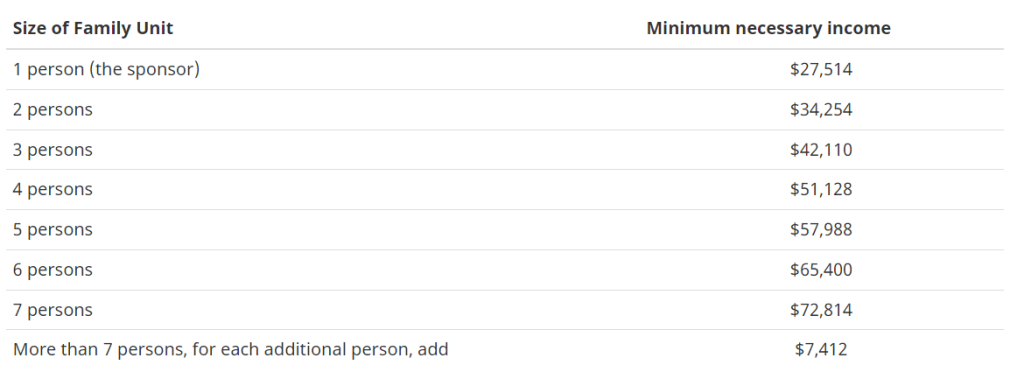
Income requirement
In most cases, there isn’t an income requirement to sponsor your spouse or partner
or dependent child. You only need to show that you have enough money to meet the
income requirements if:
-You’re sponsoring a dependent child that has 1 or more dependent children of their
own, or
-You’re sponsoring a spouse or partner that has a dependent child, and their
dependent child has 1 or more children of their own.
If you live in Quebec
You must meet Quebec’s immigration sponsorship requirements after they approve
you as a sponsor. You must sign an undertaking with the province of Quebec.
The Quebec ministry in charge of immigration will assess your income.
Who can’t sponsor their spouse, partner or child?
-You can’t sponsor your spouse, partner or child if:
-You’re less than 18 years old
-You won’t live in Canada when the persons you want to sponsor become permanent
residents
-You’re not a Canadian citizen, a permanent resident of Canada, or a person
registered in Canada as an Indian under the Canadian Indian Act
-You’re a temporary resident, that is you’re visiting, studying or working in Canada on
a visa or permit
-Your permanent residence application is still in process
You must have permanent resident status at the time you submit your
sponsorship application.
-You don’t have enough money to support the persons you want to sponsor (if
applicable)
You may not be eligible to sponsor your spouse, partner if you:
-Were sponsored by a spouse or partner and you became a permanent resident less
than 5 years ago.
-Are still financially responsible for a previous spouse or partner that you sponsored.
This means you’re still bound by the 3-year undertaking to take care of this person.
You may not be eligible to sponsor your spouse, partner or child if you:
-You have already applied to sponsor the spouse, parent or child you are currently
seeking to sponsor and a decision on that application hasn’t been made
-Are in jail, prison, or a penitentiary
Didn’t pay back:
–An immigration loan.
–A performance bond.
-Court-ordered family support payments such as alimony or child support (not
applicable if you live in Quebec)
-Didn’t give the financial support you agreed to when you signed a sponsorship
agreement to sponsor someone else in the past (not applicable if you live in Quebec)
-Declared bankruptcy and are not discharged (not applicable if you live in Quebec)
-Receive social assistance for a reason other than a disability
-You were convicted of attempting, threatening to commit or committing a violent
criminal offence, any offence against a relative or any sexual offence inside or
outside Canada
-Can’t legally stay in Canada and must leave the country because you received a
Removal Order
There may be other reasons that make you ineligible to sponsor your spouse,
partner or child. If we determine you’re not eligible to sponsor, we’ll tell you why.
You can sponsor your own parents and grandparents if:

– If you’re outside Canada, a Confirmation of Permanent Residence (COPR) and, if
necessary, a permanent resident visa will be sent to you.
– If you’re already in Canada, an electronic COPR (e-COPR) through the Permanent
Residence Portal will be provided to you.
-Check your COPR for accuracy; contact support if there are errors. Use it before it
expires.
-Keep your information updated, especially contact details.
-Confirm your permanent resident (PR) status online through the Permanent
Residence Portal.
-For PR cards, the process will initiate and provide instructions; no need to apply
separately.
-Before arriving, prepare with pre-arrival services. Upon arrival, carry necessary
documents and funds.
CBSA officers will verify your identity upon arrival; false information may lead to
denial.
-Children under 18 have entry requirements too.
-Declare funds over CAN$10,000; failure may result in penalties.
-Review CBSA guidelines for items you can bring into Canada.
-After arrival, seek immigrant services and read the Welcome to Canada guide for
assistance.
-You’re invited to apply
You’re at least 18 years old.
-You live in Canada
-You’re a Canadian citizen, a permanent resident of Canada, or a person
registered in Canada as an Indian under the Canadian Indian Act
-you have enough money to support the people you want to sponsor to show
that you have enough, you’ll have to provide your proof of income.
–you may have a spouse or common-law partner co-sign to combine your
incomes.
–you meet all other requirements under the Immigration and Refugee
Protection Act and the Immigration and Refugee Protection Regulations
If you live outside Quebec
To become a sponsor, you must promise to financially support the people you
are sponsoring for a period of time. We call this promise an undertaking.The undertaking commits you to:
-Providing financial support for your sponsored family members for 20 years,
starting when they become permanent residents
-Repaying any provincial social assistance (money from the government) your
sponsored family members get during that time
Also, you and your sponsored family members need to agree to certain
responsibilities during the undertaking period. We call this the sponsorship
agreement.The sponsorship agreement means that:
You’ll provide for the basic needs of your sponsored family members, including:
-Food
-Clothing
-Utilities
-Personal requirements
-Shelter
-Fuel
-Household supplies
-Health care not covered by public health insurance, such as eye and dental care
The person you sponsor will make every effort to support themselves and their
family members.
This agreement is still valid, and you must still cover basic needs for the
period it covers, even in the case of:-Marriage ending, separation or divorce.
-Family rifts
-Unemployment-Change in finances
Death of the main applicant, if you also sponsor their family members.
When you apply, you’ll have to complete and sign a form that includes the
undertaking and the sponsorship agreement.If you live in Quebec
You must meet Quebec’s immigration sponsorship requirements after your
sponsor is approved. The Quebec ministry in charge of immigration will assess
your income.After you have been approved as a sponsor, you will be informed on what to do
next.
You must also sign an undertaking with the province of Quebec. The length of
the undertaking is 10 years for Quebec.Who can’t sponsor a parent or grandparent?
-You can’t sponsor your parents and grandparents if:
-You haven’t been invited to apply
-You’re less than 18 years old.
-You won’t live in Canada when you apply to sponsor your parents and
grandparents and/or when your parents and grandparents become permanent
residents.
Your primary residential address must be in Canada when you submit your
application and until the decision on your application is made.
-You’re not a Canadian citizen, a permanent resident of Canada or a person
registered in Canada as an Indian under the Canadian Indian Act
-You’re a temporary resident, that is you’re visiting, studying or working in
Canada on a visa or permit
-Your permanent residence application is still in process.You must have permanent resident status at the time you submit your
sponsorship application.
-Your proof of income shows you don’t have enough money to support the
people you want to sponsor.You may not be eligible to sponsor your parents and grandparents if you:
-Are in jail, prison or penitentiary.
-Didn’t pay back.
-An immigration loan.
-A performance bond.
-Court-ordered family support payments such as alimony or child support
Footnote
-Didn’t give the financial support you agreed to when you signed a sponsorship
agreement to sponsor someone else in the past Footnote
-Declared bankruptcy and are not discharged Footnote.
Footnote: Not applicable if you live in Quebec.
-Receive social assistance for a reason other than a disability.
-Were convicted of a violent criminal offence, any offence against a relative or
any sexual offence inside or outside Canada.
-Can’t legally stay in Canada and must leave the country because you received a
Removal Order.
There may be other reasons that make you ineligible to sponsor your parents
and grandparents. If we determine you’re not eligible to sponsor, we’ll tell you
why.
Sponsor your relativses

– If you’re outside Canada, a Confirmation of Permanent Residence (COPR) and, if
necessary, a permanent resident visa will be sent to you.
– If you’re already in Canada, an electronic COPR (e-COPR) through the Permanent
Residence Portal will be provided to you.
-Check your COPR for accuracy; contact support if there are errors. Use it before it
expires.
-Keep your information updated, especially contact details.
-Confirm your permanent resident (PR) status online through the Permanent
Residence Portal.
-For PR cards, the process will initiate and provide instructions; no need to apply
separately.
-Before arriving, prepare with pre-arrival services. Upon arrival, carry necessary
documents and funds.
CBSA officers will verify your identity upon arrival; false information may lead to
denial.
-Children under 18 have entry requirements too.
-Declare funds over CAN$10,000; failure may result in penalties.
-Review CBSA guidelines for items you can bring into Canada.
-After arrival, seek immigrant services and read the Welcome to Canada guide for
assistance.
You can only sponsor relatives like a brother, sister, aunt or uncle in very specific
situations. If your family member meet the criteria below.
Depending on your situation, there are 2 options for who you can sponsor.Orphaned brother, sister, nephew, niece or grandchild
You can sponsor an orphaned brother, sister, nephew, niece or grandchild only if they meet all of
these conditions:-They’re related to you by blood or adoption
-Both their mother and father passed away
-They’re under 18 years of age
-They’re single (not married or in a common-law or conjugal relationship)You can’t sponsor your brother, sister, nephew, niece or grandchild if:
-One of their parents is still alive.
-No one knows where their parents are.
-Their parents abandoned them.
-Someone else other than their parents is taking care of them while one or both their parents are
alive.
-Their parent is in jail or otherwise detained.Other relative
You may sponsor one relative, related by blood or adoption, of any age, if you meet all of these
conditions:-You (the person who wants to sponsor your relative) don’t have a living relative you could sponsor
instead, such as a:
–Spouse
–Common-law partner
–Conjugal partner
–Son or daughter
–Parent
–Grandparent
–Orphaned brother or sister
–Orphaned nephew or niece
–Orphaned grandchild
-You (the potential sponsor) don’t have any relatives (aunt or uncle or any of the relatives listed
above), who is a:
-Canadian citizen
-Permanent resident
-Registered Indian under the Indian Act
If the relative you want to sponsor has a spouse, partner, or dependent children who will come with
them to Canada, you must include them on the same sponsorship application.Examples of who you can sponsor.
See the examples below to better understand who you can sponsor.Example 1: Eligible to sponsor an aunt
Sara doesn’t have a spouse or a common-law partner. She has no children, and lives in Canada as a
permanent resident. Her parents and grandparents have all passed away and she doesn’t have any
relatives in Canada who are Canadian citizens, permanent residents or registered Indians. Sara would
like to sponsor her aunt Betty, who she is very close with. Her aunt Betty is married and has a
daughter.Sara meets the requirements to sponsor her aunt because she doesn’t have:
-A close living relative she could sponsor instead (such as a spouse, partner, child, orphaned sibling,
parent or grandparent)
-Any other relative such as an aunt who is a citizen, permanent resident or registered Indian of
Canada.
On the application, Betty will be designated as the principal applicant and her husband will be
designated as a dependant.Betty’s daughter can be included on the application only if she qualifies as a dependent child. If her
daughter is older than the age limit or she doesn’t meet all the requirements, she can’t be added to
Betty’s application and will have to immigrate to Canada on her own.Example 2: Eligible to sponsor a cousin
Michael is an only child. His parents and grandparents have passed away. He was raised in the United
States by his only cousin. He immigrated to Canada as a permanent resident. He’s single (doesn’t
have a spouse or a common-law partner). Michael doesn’t have any relatives in Canada who are
Canadian citizens, permanent residents or registered Indians. Michael wants to sponsor his American
cousin. His cousin is single (doesn’t have a spouse or a common-law partner).Michael meets the requirements to sponsor his cousin to come to Canada because he doesn’t
have:
-A close living relative he could sponsor instead (such as a spouse, partner, child, sibling, parent or
grandparent)
-Any other relative who is a citizen, permanent resident or registered Indian of Canada.
Example 3: Not eligible to sponsor an aunt by marriage
Alexa is a Canadian citizen. The only family she had in Canada was her mother, who passed away.
Alexa has always been close to her mother’s only brother and his wife. Alexa’s uncle recently passed
away, and Alexa would like to sponsor his wife (her aunt by marriage) to come to Canada. Alexa does
not meet the requirements to sponsor her aunt, because they’re not related by blood.Who you can’t sponsor.
You can’t sponsor someone who is inadmissible to Canada. This means they’re not allowed to come
to Canada.Our experienced RCIC can help increase your chances of success
by guiding you through the process and ensuring that your
application is well-prepared.
Am I an eligible candidate for The Family Sponsorship program?
Find out whether you qualify for The Family Sponsorship program
Complete our online registration to be evaluated and we will provide our assessment within 2-3 business days.


