
Embarking on a journey that involves leaving your loved ones behind, packing up, and relocating your entire life from a place where you've spent most of your years to a foreign country where you have few acquaintances is a brave and emotionally charged endeavour. When you make the choice to initiate a new chapter of your life in a distant city far from your familiar surroundings, it becomes imperative to carefully plan for your career, financial stability, and fundamental needs like housing.
Housing choices
-Temporary accommodation, comprises options where individuals stay for shorter periods, typically ranging from a few days to several months
-Permanent, long-term accommodation, refers to housing arrangements that are intended to be stable and enduring.
Depending on the Canadian city to which you are relocating, it may require some time and effort to secure a long-term place to stay. Discovering an attractive deal on housing demands thorough research, so it is advisable to begin your search well in advance. This initial place of residence in Canada, being your first experience as a newcomer, can offer valuable insights into Canadian housing norms, help you acclimate to a
neighbourhood, and serve as a transitional step toward securing your permanent accommodation in Canada. This is why, upon arriving in Canada, many newcomers opt for temporary housing options such as hotels, hostels, apartments, condos, or houses for a few weeks or even the initial months of their stay.

Duration of stay, geographical location, and financial constraints are among the key considerations’ individuals weigh when reserving their accommodations during their initial days, weeks, or months in Canada.
When searching for rental accommodations, consider the following four key factors:
1. Online Reviews and Ratings: Given the limited opportunity for in-person inspections, it’s advisable to rely on online reviews and ratings. Look for feedback regarding issues like bed bugs, safety, cleanliness, and neighbourhood quality.
Utilize platforms that allow communication with hosts to address any concerns before booking.
2. Booking Timing: Timing matters when it comes to rental costs. Booking well in advance, especially during peak seasons like spring and summer, can offer more
choices within your budget. Demand fluctuations affect prices and availability, so planning ahead is beneficial.
3. Location and Neighbourhood: While choosing accommodations away from the city centre may be cost-effective, consider the trade-offs in terms of commute time
and expenses. Seek advice from locals, friends, and online forums to explore neighbourhood options that align with employment opportunities and lifestyle preferences.
4. Budget: Your budget is a crucial factor in the decision-making process. Most accommodation websites provide budget filtering options, so conduct thorough
research across multiple platforms to compare prices and find the best deals. This research will help you identify suitable options within your budget while ensuring
cost-effectiveness.
In summary, a successful search for rental accommodations involves evaluating
online reviews, booking well in advance, considering location relative to employment
prospects, and conducting comprehensive budget research to make an informed
choice that meets your needs and financial constraints. Familiarize yourself with available accommodation choices. If you have friends or family in Canada willing to host you temporarily as you get acclimated, that’s a helpful initial option. As you explore your possibilities, your budget will determine
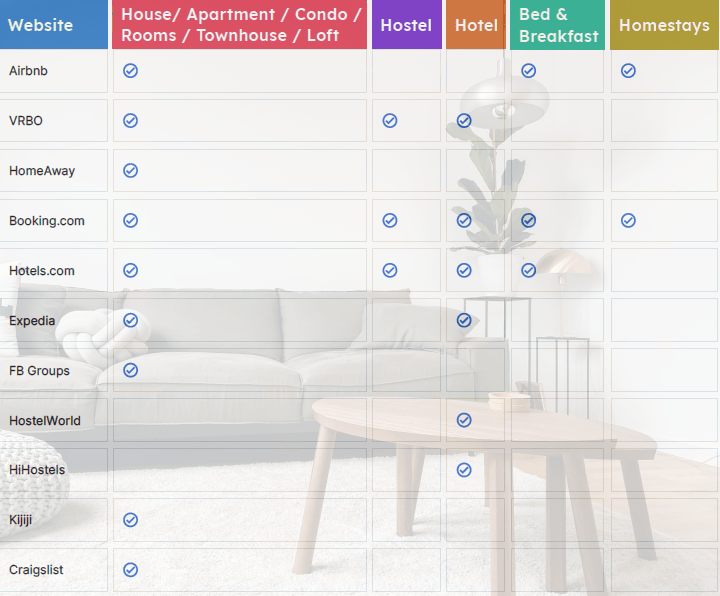
whether you can secure anything from a complete residence to a shared arrangement, covering various choices in between. A comparison of well-known Canadian websites providing temporary lodging
options.
Important: Be cautious when using classified ad websites like Kijiji and Craigslist. If a property’s price seems exceptionally low, it may likely be a fraudulent listing.
Apart from the websites mentioned earlier, such as Hotels.com and Expedia, there
are additional travel platforms available for comparing prices from various sources
and finding attractive offers. Examples include Trivago, Hotwire, Kayak, and Priceline. For newcomers in Canada, it’s crucial to keep a record of all your addresses as
you’ll need them for various formalities like obtaining identification cards, driver’s
licenses, insurance, enrolling children in school, and setting up phone plans.
Keeping track of your addresses is essential for a smooth transition.
Additionally, finding affordable and suitable accommodation in Canada can be a
time-consuming process, so it’s wise to begin your search early. Your initial place of
stay can offer valuable insights into Canadian housing and serve as a steppingstone
toward securing your first permanent accommodation in the country.
How to find your first permanent, long-term accommodation

As of August 18, 2023, union reference letters will be accepted as proof of work
experience.
Your Canadian work experience must fulfil the following conditions:
– Accumulate a minimum of one year of continuous, non-seasonal, full-time
employment within the past three years (equivalent to at least 1,560 hours).
– Work in one or more of the eligible occupations listed under the specified
industries.
– Your employment must have been through the Temporary Foreign Worker Program,
with your employer submitting a labor market impact assessment (LMIA) valid for at
least 12 months upon your hiring. You can verify this with your former or current
employer.
You will need to provide proof of your work experience, such as an employer or
union reference letter, a letter of employment, T4 forms, or pay stubs.
If you currently possess an open work permit and previously held a work permit
through the Temporary Foreign Worker Program, your work experience may be
considered. However, any experience gained while holding an open work permit will
not be counted.
– Count hours worked in full-time positions.
– Hours can be across different eligible occupations and employers.
– The cumulative hours must span at least 12 months (note: working over 30 hours
per week does not shorten this period).
– Do not count hours from unpaid activities, self-employment, part-time or seasonal
positions, or unauthorized work.
Your job offer must meet the following criteria:
– The job must fall within an eligible occupation listed under one of the qualified
industries.
– It must be full-time employment, requiring at least 30 paid hours per week.
– The job should be non-seasonal, with consistent paid employment throughout the
year.
– Employment must be of a permanent nature.
– Unionized positions must adhere to the applicable collective agreement regarding
wages.
– Non-unionized positions must meet or exceed the Job Bank’s median wage for the
occupation, either at the provincial or national level, depending on availability.
– The job must be situated in Canada, excluding Quebec.
You should possess either a Canadian high school diploma or an educational
credential assessment (ECA) report from a designated organization or professional
body, confirming the completion of a foreign credential at or above the secondary
school level.
The ECA report must be less than five years old at the time of your application and
issued after the organization’s designation date.
You must provide evidence of adequate financial resources for settling in Canada,
sufficient to support yourself and any family members, even if they are not
accompanying you to Canada.
If you are already working in Canada with a valid work permit during your application,
you are exempt from demonstrating settlement funds.
Step 1: Determine your preferred method for securing a rental, independent
search or real estate agent. When it comes to locating accommodation in Canada, you have two distinct approaches to consider:
1. Self-Guided Search: You can take the initiative to explore available rental options using a variety of online and offline resources. Websites like ViewIt and
Condos.ca can provide valuable insights into rental prices across different
neighbourhoods. For potential cost savings and more extensive listings, you may also utilize platforms such as Craigslist, Kijiji, Zumper, and Padmapper. Additionally, some regionally popular choices like Home Zone on Facebook (for Toronto and GTA listings) and Winnipeg Rental Network (for Winnipeg listings) are worth exploring. Since these websites serve as aggregators of rental listings, they facilitate direct communication between tenants and landlords.
Pro Tip: Exercise caution if a rental listing appears exceptionally advantageous; it
may be a fraudulent offer. Refrain from making any payments until you’ve
physically inspected the property and completed the necessary paperwork.
2. Employ a realtor or Real Estate Agent: Alternatively, you can opt for
professional assistance from a realtor or real estate agency. To begin your search,
Realtor.ca is a valuable resource for finding a suitable realtor. Another option is to
browse listings on platforms like ViewIt and Condos.ca, where each listing typically includes the name and contact details of the associated real estate agent, allowing you to establish direct communication. The choice between these two approaches hinges on your preferences and circumstances, with each offering distinct advantages in the pursuit of your ideal rental property.
Pros and cons: On your own / assistance of a real estate agent

Cost: CAD $250 and $625 per month
-For international students considering on-campus living arrangements, the choice
between dormitories and condominiums offers different advantages. Dormitories,
situated either within or close to the university campus, provide rooms designed for
multiple students to share. Conversely, condominiums are self-contained
apartments, typically smaller than dormitories, accommodating three to five students.
-Dormitories feature both single and shared rooms, along with communal areas such
as living and dining spaces, internet access, basic furnishings, and meal options.
This proves to be a highly convenient accommodation choice for Indian students in
Canada due to its proximity to the campus and comprehensive facilities.
-Condominiums consist of individual rooms, with some units offering up to six
bedrooms, each with a separate kitchen and living area. Both options include access
to a cafeteria or separate food court.
-Students planning for one or two semesters may consider these on-campus living
options instead of seeking off-campus housing. Their proximity to the campus also
grants access to university facilities like the library. To secure a dormitory spot,
contact the university’s student housing department upon receiving your acceptance
letter. Keep in mind that housing and meal plans can vary from one university to
another.
Cost: CAD $400 and $800 per month
Townhouses are the type of accommodation offered by Canadian universities that
have three or five-bedroom houses located in or nearby the campus. This housing
includes single or shared rooms, basic furnishing, kitchen equipment, shared
common space, and WI-FI. This type of accommodation is usually offered to third or
fourth-year undergraduate and postgraduate students.
Understand your privileges and responsibilities as a renter in
Canada.
The compilation of tenant rights and responsibilities can be quite extensive and
varies depending on the specific province or territory in Canada. Below, we’ve
highlighted some crucial ones you should take note of:
Rent increase regulations in Canada vary across provinces and territories. Some
provinces have government-set limits on annual rent increases, while others, like
Alberta, have no limits. Landlords must notify tenants before increasing rent, with the
notice period varying by province.
Rent payment rules differ by province; for example, Ontario requires first and last
month’s rent, while Vancouver may require a one-month security deposit. Most
provinces have one-year leases, defaulting to month-to-month afterward unless a
new lease is signed. Notice periods for moving out vary by province, so it’s important
to consult the guidelines for the specific province you plan to move to.
Landlords must provide advance notice when entering your apartment, whether it’s
for housekeeping, renovations, or showing the unit to prospective tenants if you’re
moving out. Moving to a new location can be daunting, but proper preparation,
research, and resources will help you find your ideal home.
On your own Pros:
1. You have the flexibility to explore various online alternatives and carefully compile a list of potential choices.
2. It’s feasible to come across favourable bargains, including more affordable or
budget-conscious selections, when compared to enlisting the services of a real
estate agent.
Cons:
1. Demands a significant amount of time, necessitating extensive research and
exertion.
2. There is a risk of falling victim to fraud if the listing lacks authenticity.
3. Identifying unlawful activities during the rental process may pose challenges.
4. You’ll be responsible for deciphering and handling all the necessary documentation. Assistance of a real estate agent Pros
1. You won’t be responsible for paying any fees to the real estate agent; these fees are covered by the landlord, not the tenant.
2. Realtors are well-equipped to assist with all necessary paperwork and can
manage the entire leasing process from beginning to end.
3. You’ll have access to exclusively legitimate and bona fide property listings,
reducing the risk of falling victim to scams.
4. Agents can provide a valuable wealth of expertise and experience gained through their work in the industry.
5. It’s a time-efficient and hassle-free option.
Cons:
1. Because the landlord covers the realtor’s commission, this expense might be
included in the rental price.
2. You may need to make quicker decisions.
3. Your choices are confined to what the realtor can provide access to.
4. Finding affordable deals could prove challenging.
Step 2: Determine the locality, once you’ve settled on the Canadian province and
city where you intend to relocate, the subsequent task involves pinpointing a specific neighbourhood in which you’d prefer to reside. During your neighbourhood exploration, it’s important to consider several factors,
including:
1. Average rental prices within a specific neighbourhood
2. Commute duration to the primary downtown or major business districts
3. Monthly commuting expenses
4. Walkability and public transportation accessibility ratings
5. Distance to educational institutions, your workplace, grocery stores, public
transportation, shopping centres, religious institutions, and more.
6. Availability of parking facilities
7. Crime statistics
8. Levels of ambient noise
Advise: Seek housing in a central location or near public transportation rather
than choosing a place based solely on its proximity to a (potential) workplace. With the recent increase in remote work opportunities due to the pandemic, it’s crucial to carefully assess your preferences regarding geographic location and living space size.
Step 3: Select the housing category. Familiarize yourself with various housing options: Apartment: Apartments come in various forms, from walk-ups in low-rise buildings to those with elevators. Amenities can range from in-unit laundry to shared facilities like common rooms and fitness centres. Condominium (Condo): Condos are units in high-rise buildings with shared amenities like gyms and pools. Rooming House: Rooming houses rent individual rooms with shared kitchen, bathroom, and living spaces. House: Houses include townhouses, duplexes, semi-detached, and single-detached houses, often with multiple apartments. Basement Apartments: Basement apartments offer more space and access to outdoor areas in houses. Bachelor Unit/Studios: These smaller units are found in apartments and condos, combining bedroom and living area in one space. Suggestion: Consider basement apartments as they are often more cost-effective and roomier than apartments or condos. Additionally, individual landlords are often open to newcomers, even those without a Canadian credit history or job letter, making them a flexible choice.
Step 4: Search for listings that match your requirements, while searching for
appropriate housing, utilize online filters to refine your choices, or if you’re working with a real estate agent, make sure to clearly communicate your preferences. During the selection process, consider posing these inquiries to the landlord or real estate agent:
Rent details: Inquire about what’s covered in the rent, such as utilities (e.g., water,
electricity, heating, AC, internet, cable), and whether parking is an additional cost.
Pets: Check for any pet restrictions in the building if you own or plan to get a pet.
Guest policy: Be aware of any rules regarding guests and “quiet hours” depending
on the type of accommodation. Interior decor rules: Confirm if permanent property changes are allowed and inquire about personalizing your space.
Lease duration: Not all rentals have a year-long lease; ask about shorter or longer
lease options. Move-in date: Typically, units are listed two months before the move-in date (e.g., an August 1 listing is available on October 1). Most rentals start on the first of the month, but exceptions may apply. Payment methods: Check with the landlord about acceptable payment methods (cash, checks, e-transfer, bank transfer, etc.), and if they prefer a specific method.
Suggestion: When inspecting a potential place to stay, snap photos to create a
visual record of any damages or visible concerns. This can be valuable when
discussing rental terms with the landlord. Planning your finances for renting in Canada Rent varies depending on factors like location, unit size, demand, and included amenities. You can get a sense of prices on websites/apps like ViewIt, Condos.ca, Zumper, and Padmapper. Monthly costs often include AC and heat (a major part), hydro ($50-80 CAD), water ($20-40 CAD), internet, cable TV (over $100 CAD), and possibly garbage removal.
Note:
– CMHC’s rental market reports offer comprehensive market insights.
– Use Arriva’s Cost of Living Calculator for better financial planning.
– Remember, your monthly accommodation expenses go beyond rent; consider
utilities, parking, insurance, and transit passes. What seems affordable at first may not be.
Step 5: Gather necessary paperwork, to secure a rental property, you’ll need to
furnish specific documents to demonstrate your ability to make timely rent payments and afford the space.
Landlords might request:
1. Employment verification letter including salary information.
2. Credit report.
3. References (from friends, family, or past Canadian landlords).
4. Bank statements.
Guiding newcomers through the challenges they face
-Newcomers who haven’t secured employment can enhance their rental prospects by demonstrating financial resources that cover several months of rent or by arranging for a local guarantor or co-signer.
-If you lack a credit history, you can compensate by furnishing a bank letter or statements indicating ample funds to cover rent for an extended period.
Getting a credit report Newcomers typically wait a few weeks to a month to receive their first Canadian credit card and then a few more months of credit transactions to establish a credit history. In Canada, the two primary credit rating agencies are EQUIFAX and TransUnion. You have the option to obtain your credit report from either of them, but EQUIFAX is the preferred choice and is often requested by most landlords when they ask for a credit report.
Step 6: Complete the lease contract, a lease is a written agreement that
summarizes your rental arrangement with the landlord. It includes details like rent
amount, lease duration, rules regarding pets and smoking, and what occurs at the
lease’s end. After choosing the rental property, you’ll need to fill out an application
form for the landlord’s approval. If accepted, the landlord will provide you with the
lease agreement to review and sign. Following these initial steps, you’ll be responsible for making required payments, which may encompass first and last month’s rent, a security deposit, key deposit, and pet deposit, depending on your location.
Key Advice:
1. Safeguard your lease agreement as it can be required for various administrative
purposes like obtaining a driver’s license or provincial insurance.
2. Thoroughly review the lease, including any extra clauses or schedules added by
the landlord. If these go beyond what’s defined in the provincial Residential
Tenancies Act, you aren’t legally bound by them even if you sign.
During this phase, certain landlords might request that you purchase renter’s
insurance. Take the time to explore various insurance providers to discover one that suits your needs. Some newer agencies like Square and Sonnet offer competitive pricing.
Suggestion: When subleasing from a current tenant, it’s essential to maintain a
clear payment record. If you’re using cash, make sure to obtain a receipt.
Furthermore, ensure that the sharing of utility expenses is well-documented.
After completing all the necessary paperwork and fulfilling your payments, your
landlord will provide you with the keys to your new residence.
Step 7: Arrange for the transfer of utilities, in many cases, when moving into a
previously occupied unit, you’ll need to take over utilities like electricity (hydro) from the previous tenants or the landlord. Suggestion: Since there are various hydro providers, it’s crucial to ensure you have the correct company name. Verify this information with your landlord, real estate agent, or building management. The process for transferring hydro services is typically done online and usually takes about a day to receive confirmation. There’s no need for you to visit a physical location to complete this task.
Step 8: Move in!
Once you’ve signed the lease, received the keys, and transferred the utilities, it’s
time to move-in! Check with your landlord and/or building management for any
additional paperwork you may have to fill out after moving in. Suggestion: Most condo and apartment buildings have specific dates and times when the service elevator is available. Ensure you book it in advance to move in your larger items and furniture.
Move to Canada Today!
Find out whether you qualify for The Family Sponsorship program
Complete our online registration to be evaluated and we will provide our assessment within 2-3 business days.


