
Getting your Phone and internet Provider in Canada
Remaining in touch with family, job hunting, and adapting to your new Canadian life all rely on reliable cell phone and internet services. Canada's telecommunications sector is welcoming to newcomers, but it can be complex when you're starting a fresh chapter in a new country. Familiarizing yourself with different telecom providers and their available services can empower you to make an informed choice when selecting your initial phone or home internet service in Canada.
Mobile Phone Companies in Canada
In Canada, there are three major mobile phone service providers, commonly referred
to as ‘The Big Three’:
1. Rogers
2. Telus
3. Bell
Many of the other mobile network companies are either owned by these three or have significant partnerships with them. Some of these subsidiary or partner companies include:
– Public Mobile
– Chatr Mobile
– Lucky Mobile
– Fido
– SimplyConnect
– Freedom Mobile
– Virgin Mobile
– Koodo
Each of these mobile network providers offers distinct features, catering to various needs. Some focus on student phone plans, while others excel in family cell phone plans or budget-friendly mobile phone options. For instance, the top family plan in Canada for household use typically provides discounts and special offers for family units, covering calls, messaging, and internet data bundles.
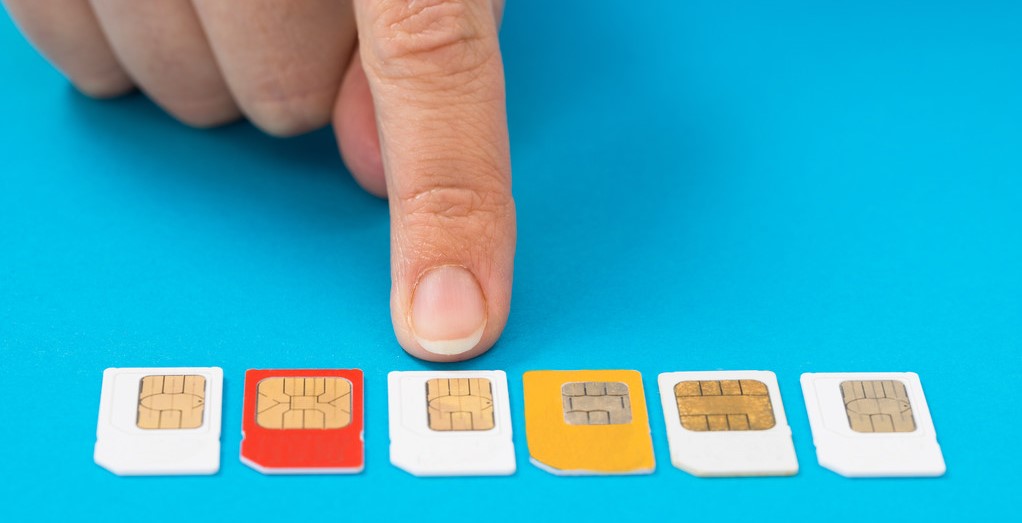
For newcomers looking to initiate a new phone plan in Canada, the following documents may be required:
- Government Identification (Provincial ID, Passport,)
- Social Insurance Number (SIN) – This may be necessary depending on your chosen service provider. For further information on understanding what a SIN entails, please click here
- Temporary residence visa/permit (e.g., study/work visa or permit)
- Credit score or credit check -The requirement for this may vary based on the type of plan you are selecting. To ensure clarity regarding the specific documents needed for your particular situation and phone plan, it is advisable to consult with your chosen service provider.
Top Mobile Phone Plans in Canada

Several key factors newcomers might want to take into account when selecting a
phone plan encompass:
1. Choosing between pre-paid and post-paid phone plans can be influenced by
factors such as accessibility and cost-effectiveness. Pre-paid plans often limit usage
to what has been paid for, making them cost-effective but potentially inconvenient if
you exceed plan limits. In contrast, post-paid plans offer added convenience,
especially if you frequently surpass plan limits, though they may require a credit
check.
Considering coverage is vital, especially based on your location. Ensuring that your
selected phone plan and provider offer adequate coverage in your area is crucial.
When starting a new phone plan, newcomers can choose to finance a new device,
with the cost added to their monthly bill. This option is ideal for those in need of a
new device and willing to commit to a fixed-term contract. It allows for obtaining a
new phone with manageable monthly payments.
Data plans are essential for newcomers as they provide internet access and
facilitate communication through various apps and services. While they can increase
phone bills, many consider them a valuable service.
Family plans are offered by many providers, allowing multiple family members to
share a single plan with bundle deals on data, talk, and text at reduced rates.
For international calling, providers often offer add-on options to their phone plans.
Rates for international calls depend on your carrier and the destination, providing a
way to stay in touch with loved ones abroad.
In Canada, there are two main types of mobile phone plans: pre-paid and post-paid.
Pre-paid plans, involve paying for your services upfront, so you can only use what
you’ve already paid for.
Post-paid plans, on the other hand, require payment after you’ve used the services
during your billing cycle. These plans are often associated with contracts, and some
may require a credit check to ensure you can cover the costs. However, exceptions
might be made for newcomers to Canada.
Options to purchase a phone from service providers or Bring-Your-
Own-Device (BYOD).
Apart from prepaid and postpaid options, newcomers can decide whether to use
their existing device or finance a new one through their service provider when
choosing a cell phone plan.
Typically, new phone plans come bundled with a brand-new device, and the cost is
spread out over monthly payments added to your phone bill. However, because
these plans involve additional expenses, many newcomers who are satisfied with
their current phones opt for a Bring Your Own Device (BYOD) plan. Another choice
available in Canada is to purchase a phone outright at the time of acquisition.
Here are the top mobile phone plans in Canada:
1. Best Smartphone Plan in Canada: Virgin Mobile ( BYOP/research )
– Virgin Mobile offers high-quality service, although it may not be the cheapest.
– They responded to the government’s call for reduced cell phone plan costs with a budget-friendly $41.25 plan for 4GB of data.
– Subscribers in Ontario and Quebec can combine this plan with Virgin’s home
internet for a $20 discount on home plans for 12 months.
2. Best Unlimited Data Plan in Canada: Telus
– Telus Mobility provides the best unlimited data plans in Canada.
– Telus offers the Telus 20 plan at $80/month, providing 20GB of full-speed internet, suitable for most users.
– You can use your own device or choose from Telus Mobility’s selection.
3. Cheapest Prepaid Mobile Plans: Public Mobile
– Public Mobile offers cost-effective prepaid plans to control your mobile data expenses.
– Their popular 1GB + Canada-wide Talk + Text plan costs just $23/month.
– Public Mobile also provides various bonuses, such as autopay credits, referral rewards, and community forum contributions.
4. Best $0 iPhone Deals in Canada: Koodo
– Koodo offers appealing deals on iPhones, such as the iPhone 12 mini at $26/month for 24 months.
– Additional options for data and minutes are available for specific plans.
5. Best $0 Android Deals in Canada: SimplyConnect
– SimplyConnect offers budget-friendly deals on the Samsung Galaxy A51 at $45/month with a $150 credit for new customers.
6. Cheap Talk and Text Mobile Plans in Canada: Chatr Mobile
– Chatr Mobile provides affordable options, including a $15/month plan with 100 minutes or a $25/month plan with unlimited talk time, both featuring unlimited minutes on the Roger Network.
7. Best Data-Only Mobile Phone Plans in Canada: Freedom Mobile
– Freedom Mobile offers a 17GB full-speed data plan for $50, ideal for those who mainly use data and messaging apps.
8. Best Family Sharing Mobile Plans in Canada: SimplyConnect
– SimplyConnect offers practical family-sharing plans, with a $59/month option for two phone lines, including unlimited talk, text, and 3GB of data. These plans cater to various needs and preferences in Canada’s mobile phone market.Whether you’re a student or a new immigrant, it’s crucial to assess your data needs and consumption patterns when selecting a plan. Your choice of mobile plan should align with your specific requirements, the key is to find an affordable plan that meets your needs without straining your budget. Suggestion: While major Canadian providers offer similar services, it’s essential to verify the coverage quality in your province/area of residence. You can find coverage maps on provider websites, illustrating network reach and strength. If you’re considering another provider, search for their coverage map to assess their area network. Free websites and apps can also help newcomers compare service providers and coverage options, though official maps are more reliable.
Varieties of internet connectivity options accessible in Canada

Home internet prices in Canada can be relatively high. Basic plans typically start at
$50-55 CAD per month before taxes, offering speeds of 10-20 Mbps. Premium
plans, costing $110-125 CAD per month, provide speeds of up to 3 Gbps. Most
Canadian home internet plans include modem rental as part of the package.
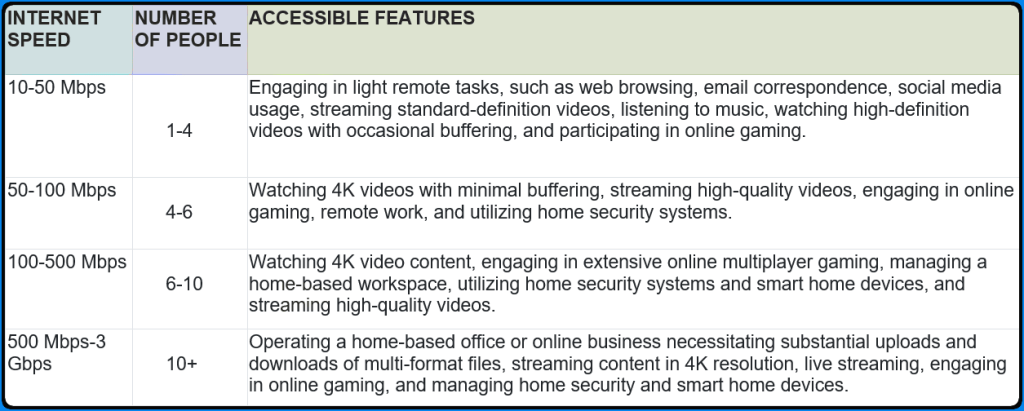
Internet speeds in Canada can vary widely, from 10 Mbps to 3 Gbps for both
downloading and uploading. Your ideal speed depends on your internet usage and
the number of users in your network.
1. When considering internet plans, two crucial aspects to consider are speed and
bandwidth. Speed pertains to the rate of data transfer, while bandwidth determines
the capacity to connect multiple devices simultaneously while maintaining a
seamless user experience.
2. In the context of home internet, it’s essential to understand how internet speed’s
function. The maximum download and upload speed of your internet connection is
provided by your Wi-Fi modem. This speed is then distributed across your household
and its devices. The actual speed experienced by your device is contingent on its
own limitations, typically falling within a range of 150-350 Mbps for most devices,
with newer models continually pushing this limit.
3. The number of connected devices also influences speed, often referred to as
bandwidth. Bandwidth plays a critical role in various aspects of internet usage,
including the responsiveness of webpages. A higher bandwidth, measured in Mbps
or Gbps, ensures the ability to connect multiple devices and perform multiple tasks
concurrently without compromising connection speed or quality.
Once you’ve selected a suitable provider and plan, the activation process can be
carried out either in person at a physical store or online/over the phone. Visit your
chosen point of sale to make the plan purchase.
During the transaction, you’ll probably be prompted to arrange a delivery and
installation time for your new Wi-Fi modem. Activation finalizes when a technician
visits your home to set up the modem. Subsequently, you will receive monthly billing
as per the pre-arranged cycle.
In the major metropolitan areas of Toronto, Vancouver, and Montreal, as well as their surrounding regions, private internet connections primarily rely on high-speed fibre optic cables. Fiber optic technology utilizes light pulses transmitted through glass or plastic fibres to achieve rapid data transfer speeds of up to 3GB/s for both downloads and uploads. This is especially popular among users with high-speed and bandwidth requirements, including competitive gamers, remote professionals dealing with large files or remote teams, and online broadcasters.
-In areas farther from city centres, cable internet is a common choice. Although it offers somewhat slower speeds, typically ranging from 100-150 Mb/s for downloads and uploads, it is suitable for HD streaming, medium-sized file transfers, and instant messaging applications.
-Other internet connection alternatives include satellite internet for extremely remote locations, limited availability of 5G internet, and mobile internet solutions that often involve using a Wi-Fi hotspot from a mobile device or an external internet dongle to connect desired devices to the internet.
-Additionally, many home internet plans offer bundled packages that include television services, combining both services into a single payment plan with cost savings and extra features.
-Most frequently, internet is delivered via a Wi-Fi connection, with service providers providing a wireless modem for new home internet activations. However, wired connections to devices remain an option, as most wireless modems feature Ethernet ports for cable connections.
Start your connection to Canada today!
Complete our online registration to be evaluated and we will provide our assessment within 2-3 business days.


